
Delibra
A meeting always leaves two records: what actually happened, and what somebody managed to write down afterwards. Between the two there are handwritten notes, an agenda in a word processor, and minutes reconstructed from memory the following week.
Delibra runs the meeting while it is happening. The minutes are assembled from what took place, and the clerk corrects instead of transcribing.
The meeting, end to end
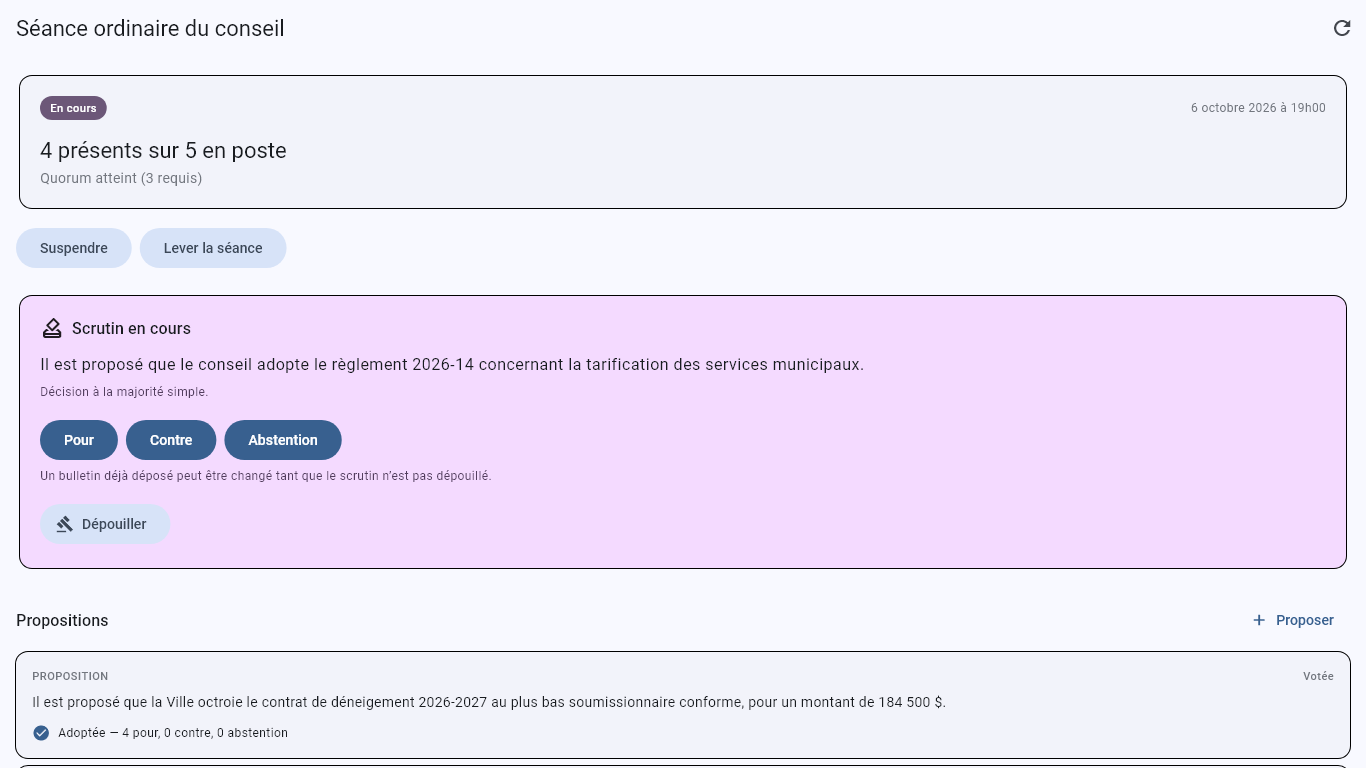
The agenda is built with its documents and published. The notice goes out to members, based on who held a seat on the day of the meeting. Then, in the room, the application takes over: the roll call, quorum computed on its own, motions put to a vote, ballots counted.
Quorum, live
Established from actual attendance and filled seats, not from a theoretical list. If quorum is lost during the meeting, the application refuses to open a vote.
Votes that hold up
For, against, abstention. A ballot already cast can be changed until the vote is counted — and not after. The outcome is computed by your rules, not by an imposed majority.
Minutes that write themselves
Attendance, motions, outcomes and resolutions land in them on their own. The clerk reviews, corrects what needs correcting, then adopts and publishes. Every version stays available.
Resolution numbers
Assigned by the application, in order, with no gaps and no duplicates. A decision keeps its number forever, and that is how you find it again.
The rules are yours
Quorum, majority, how abstentions count, the chair’s casting vote, each seat’s right to vote: your organization configures them, not us. A municipality does not deliberate like a board, an executive committee does not deliberate like a general assembly, and two municipalities do not deliberate the same way.
Delibra dictates no voting rule. It applies yours, and refuses what they forbid — a vote without quorum, a ballot from a seat that has no right to one, a set of minutes adopted by the very meeting it describes.
A decision does not end at the vote
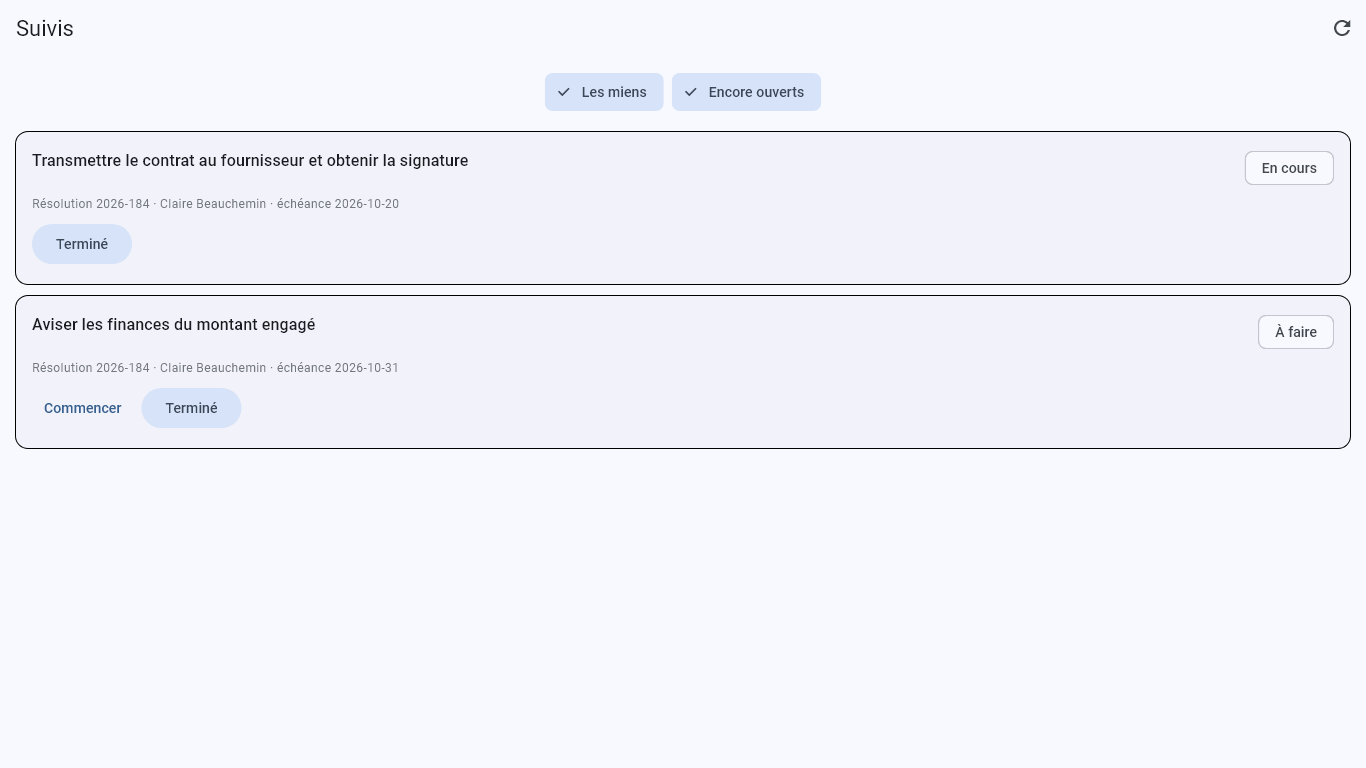
What the council decides, somebody has to carry out. Follow-ups are created from the resolution that triggers them, with an owner and a due date, and they stay attached to it: you always know which meeting an obligation came from, and where it stands.
Several bodies, one organization
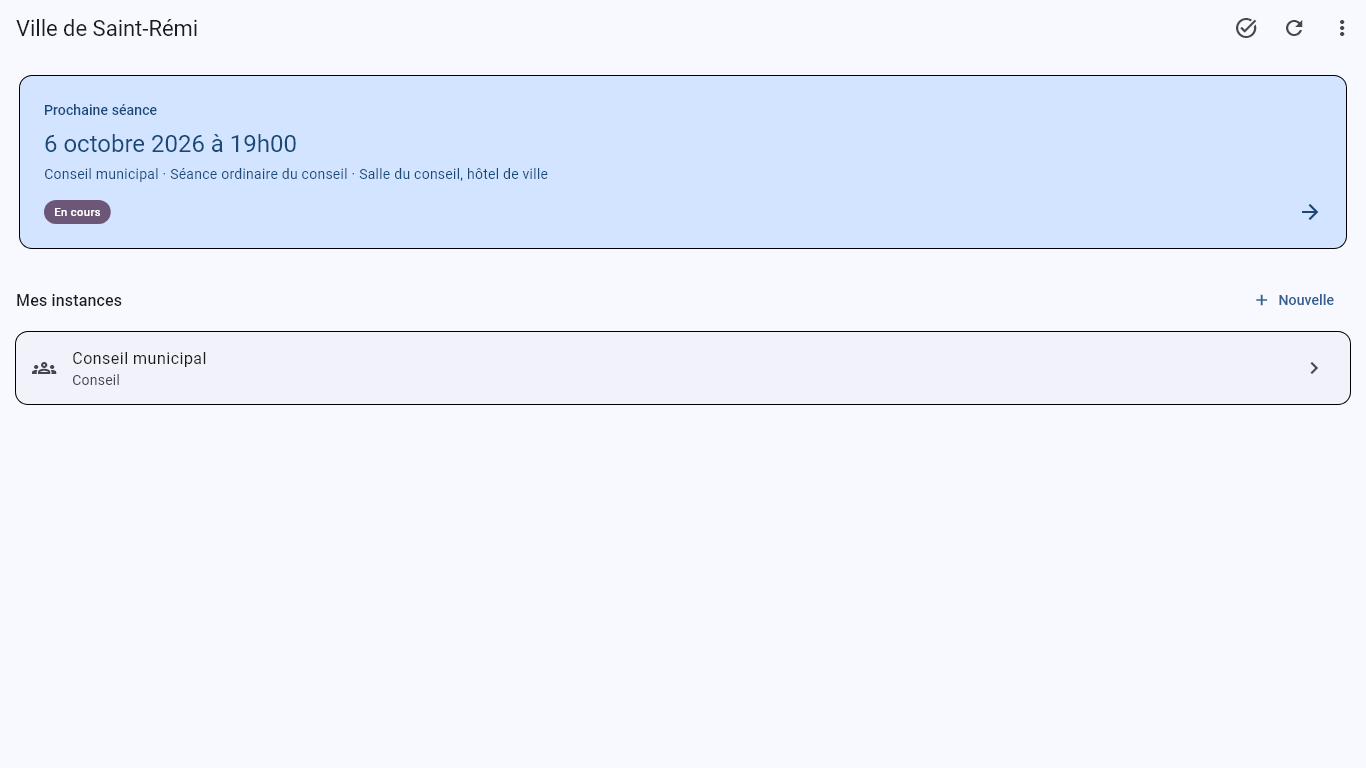
The council, the executive committee, the planning advisory committee: each has its own seats, members and rules, under a single organization. A member only sees what belongs to the bodies they sit on, and documents carry a confidentiality level that decides who may open them.
Who it is for
Municipal councils, boards of directors, executive committees, condominium associations, non-profits, professional orders — any body that deliberates, that decides, and that must be able to prove what it decided.
Delibra is used with an organization account: members are invited by email, and each one only reaches what concerns them.
Getting Delibra
Delibra installs free of charge from all three stores, and runs at no cost on the Discovery plan: one board, five members, two meetings a month, with no end date.
- Your device Windows 10 and 11 Microsoft Store
- Your device Android, phone and tablet Google Play
- Your device iPhone and iPad App Store
On invoice, for an organization
Two yearly plans go through no store: they are ordered here and invoiced to your organization, against a purchase order if you need one. The plan is applied to the Delibra account whose address you give when ordering.
Create your organization in the application first, then order: your address is what ties the invoice to the account. An order placed before the account exists cannot be fulfilled.
The monthly plans are bought inside the application, from your device’s store.
A web version is also in preparation, for workstations that install nothing. Write to us to be told when yours arrives — or if your organization would like to try it sooner.
Your deliberations stay yours
Data is kept in Québec, on infrastructure we operate in Montréal. No advertising, no trackers, nothing resold: Delibra has one source of revenue, and it is what its users pay.
A member who leaves can close their account from within the app. Their address and password disappear; their name remains where it already appears — attendance, ballots, resolutions, minutes. Those are records of acts: a councillor who leaves does not erase their vote from the February meeting.
Let’s talk about your meetings
Tell us how your organization deliberates today, and what costs you the most time. We will show you Delibra with your own rules.
Réseau Inter-Système inc. — Marc Grenier, President
514 317-2311 · admin@inter-systeme.ca
Same-day reply.